
Anchorage Divorce Decree Records
Divorce decree records for Anchorage are maintained at the Anchorage Superior Court, part of Alaska's Third Judicial District at the Nesbett Courthouse. If you need to search for a divorce decree, look up a dissolution case, or get a copy of a final order, this is where those records are kept. You can start your search online using Alaska's CourtView public access system, which covers all Superior Court filings including divorce and dissolution cases. CourtView does not show document images, but it gives you the case index and details needed to request the actual decree from the clerk's office. In-person visits are often the fastest path to getting copies when you already know the case number.
Anchorage Quick Facts
Where Anchorage Divorce Records Are Filed
Anchorage is part of the Anchorage Municipality, and all divorce and dissolution filings for the city go through the Anchorage Superior Court. This court handles the largest volume of divorce cases in Alaska. The courthouse is at 825 West 4th Avenue in Anchorage, and the clerk's office is where all case files and final decrees are stored. If you live in Anchorage and need to file for divorce or get records from a past case, the Anchorage Superior Court is your starting point.
The court serves the entire Anchorage Municipality, which takes in the city proper and surrounding communities. Every divorce and dissolution case goes through the Superior Court. The District Court in Anchorage does not handle divorce cases. Those are a Superior Court matter only. When you look up a case on CourtView, cases from Anchorage will carry the 3AN prefix, a two-digit year, and a five-digit number with the CI suffix. An example case number looks like 3AN-22-04567CI.
The official Municipality of Anchorage website does not hold divorce records. Those records live with the Alaska Court System, not the local borough government.
Anchorage Superior Court Details
The Anchorage Superior Court sits inside the Nesbett Courthouse at 825 West 4th Avenue. It is the busiest trial court in Alaska. The clerk's office handles all records requests for divorce decrees, including in-person pickup, mail-in orders, fax requests, and email submissions. For general records questions, you can reach the court at (907) 264-0514. To send a fax with a copy request, use (907) 264-0873. The email address for records requests is 3ANRecordsRequest@akcourts.gov.
| Court | Anchorage Superior Court, Third Judicial District |
|---|---|
| Address | Nesbett Courthouse 825 West 4th Avenue Anchorage, AK 99501 |
| Phone | (907) 264-0514 |
| Fax | (907) 264-0873 |
| 3ANRecordsRequest@akcourts.gov | |
| DV Office Hours | Mon-Fri 8am-8pm; Sat-Sun 12pm-8pm |
| Case Prefix | 3AN (format: 3AN-YY-#####CI) |
| Copy Request Form | TF-311 ANCH |
The Anchorage Superior Court directory lists all current contacts, division phone numbers, and service details. Check this page before you call or visit since hours and staff contacts can change.
The Anchorage Superior Court directory at courts.alaska.gov provides current addresses, phone lines, fax numbers, email contacts, and service hours for every division at the courthouse.
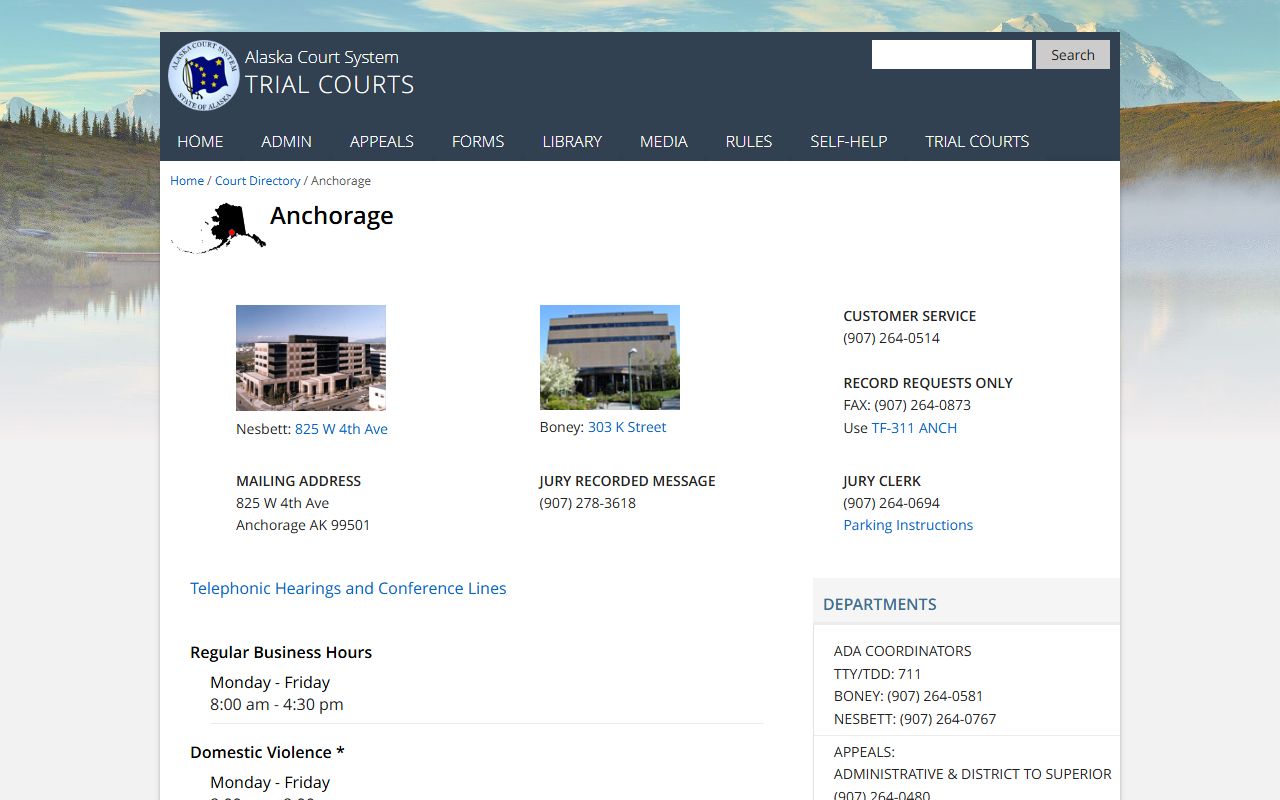
Review the directory before sending a records request to confirm the right fax number or email for your specific need.
Searching Anchorage Divorce Decree Records Online
CourtView is the primary tool for searching Anchorage divorce decree records online. It is the Alaska Court System's public case access portal and covers all Superior Court cases filed in the state. You reach it at records.courts.alaska.gov. No account is needed. You can search by the name of either party or by case number. A name search returns a list of matching cases. Click any result to see the case type, filing date, current status, and docket entries.
CourtView shows the case index, not the actual documents. You will see that a divorce was filed and when, who the parties are, and what stage the case is at, but you will not see the text of the decree itself. To get the actual decree, you need to submit a copy request to the clerk's office. Form TF-311 ANCH is the copy request form for Anchorage. You can find all Alaska court forms through the Alaska Court System forms catalog. Fill it out and submit it in person, by mail, by fax, or by email. If you have the case number, in-person requests are often filled the same day.
If you do not have a case number, staff will search for it, but a research fee of $30 per hour applies for staff time. Having the names of both parties and the approximate filing year speeds things up. Third-party sites like also index Anchorage cases and can be useful for a quick name check before you go to the courthouse.
Alaska's CourtView public access portal lets you search all Anchorage divorce and dissolution cases by name or case number without creating an account.
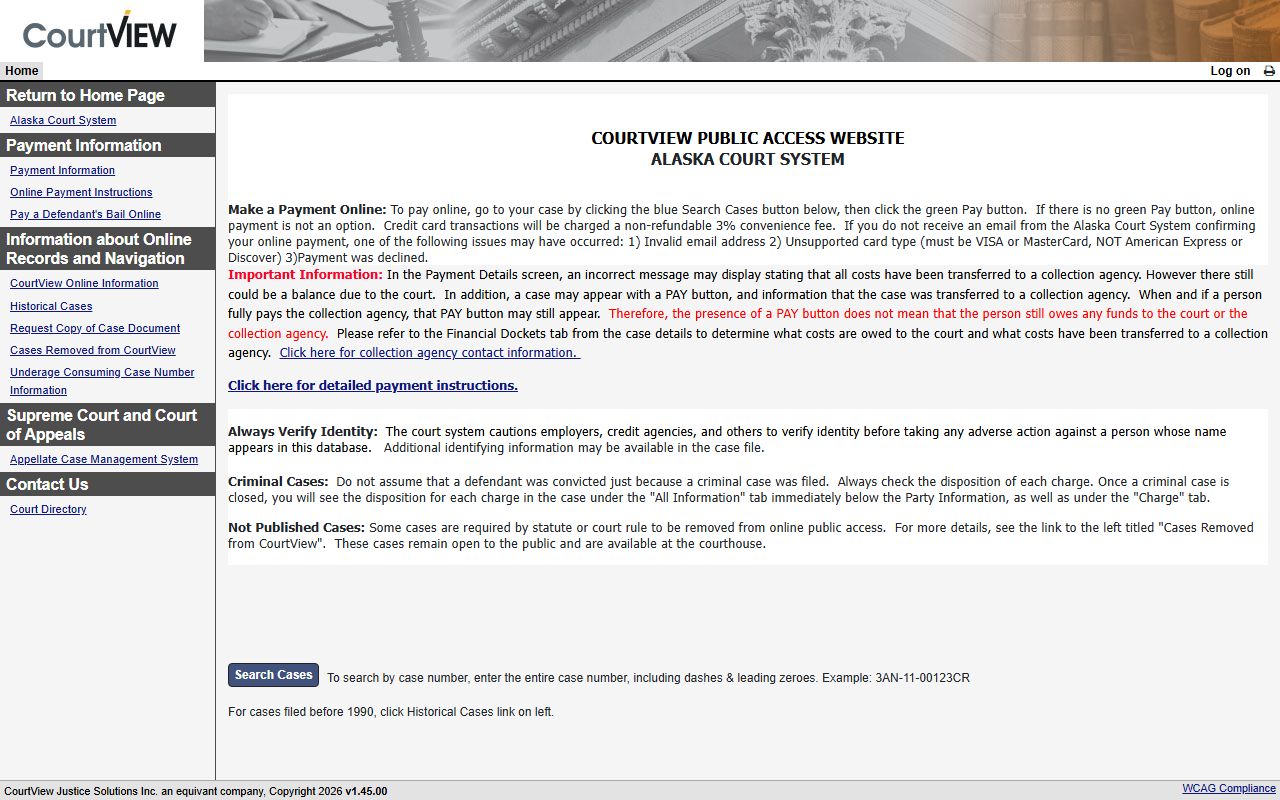
CourtView returns case status, party names, filing dates, and docket entries for all Anchorage Superior Court divorce filings.
Copies of an Anchorage Divorce Decree
The Anchorage Superior Court charges standard Alaska court fees for copies. A plain copy costs $5 for the first page and $3 for each page after that. A certified copy costs $10 for the first page and $3 per additional page. If you do not know the case number and need staff to locate the file, a research fee of $30 per hour applies. These fees are set statewide and are the same across all Alaska Superior Courts.
To request copies, complete form TF-311 ANCH. Include the names of both parties, the approximate year the case was filed, the case number if you have it, and whether you need plain or certified copies. You can pick up in person at the Nesbett Courthouse or mail your request with payment. For people who cannot pay, form TF-920 is the fee waiver application. Submit it alongside your copy request and the court will review your situation. The Alaska court forms page has both forms available to download.
Note: Mailed requests can take longer to process than in-person visits. If time matters, go in person with a case number.
Anchorage Vital Records and Divorce Certificates
The Alaska Bureau of Vital Statistics holds a divorce certificate that is separate from the divorce decree kept at the court. These are two different documents serving different purposes. The decree is the full court order with all terms. The certificate is a short summary record that confirms the divorce happened and lists basic facts like names and the date. If you need to prove a divorce occurred for a legal or official purpose, either document may work depending on what the requesting agency needs.
The Anchorage Vital Records Office is at 3901 Old Seward Highway, Suite 101, Anchorage, AK 99503. Call (907) 269-0991 for questions. They are open Monday through Friday, 8:30am to 4:30pm, and accept walk-ins. You can also order records through the Alaska vital records online ordering system or visit the Alaska Bureau of Vital Statistics website for more information. Divorce certificates are not public until 50 years have passed from the date of the divorce. Newer records have restricted access.
What an Anchorage Divorce Decree Includes
A final divorce decree from the Anchorage Superior Court is the court order that ends the marriage. It carries the legal weight of any court judgment. The document names both parties, states the date the marriage is dissolved, and sets out every term the court approved. That can include property division, debt allocation, spousal support, and if children were involved, custody arrangements and child support.
Cases without children use decree form DR-806. Cases with children use form DR-805, which also includes a parenting plan. The parenting plan sets a custody arrangement and a schedule. If a name change was requested during the divorce, it appears in the decree itself. That entry in the decree is the legal document you show to update your driver's license, passport, Social Security card, and other records. You do not need a separate court order for a name change that was part of the divorce.
Most Anchorage divorce records are public. The exceptions are records that have been sealed by court order, records from certain protective proceedings, and cases where the court restricted access to protect a party or witness. For most cases, any member of the public can request a copy from the clerk's office.
Divorce and Dissolution Process in Anchorage
Alaska law offers two paths to end a marriage, and both are handled by the Anchorage Superior Court. A dissolution of marriage is for couples who agree on all terms before filing. Both parties sign the paperwork together and submit it. This is the faster, cheaper option when there is no dispute. A divorce is for cases where the parties disagree. One person files, the other is served, and both sides present their positions to the court. A judge decides what the parties cannot resolve on their own.
For an uncontested dissolution without children, you start with form DR-100. When children are involved, use form DR-105. Both forms are available from the Alaska Court System forms catalog. After filing, Alaska law requires a minimum 30-day waiting period before the court can enter a final decree. This applies to both dissolution and divorce cases. The governing statutes are in Alaska Statutes Title 25, Chapter 24 (AS 25.24). These statutes set out the grounds, the process, property rules, and support obligations.
People handling a case without a lawyer can get help from the Family Law Self-Help Center. The Anchorage helpline is (907) 264-0851. Toll-free statewide: (866) 279-0851. The center does not give legal advice, but staff help with forms and process questions. Alaska Law Help has written guides on divorce and dissolution that are specific to Alaska courts and procedures.
The Alaska Family Law Self-Help Center offers guided assistance for Anchorage residents handling their own divorce or dissolution case without an attorney.
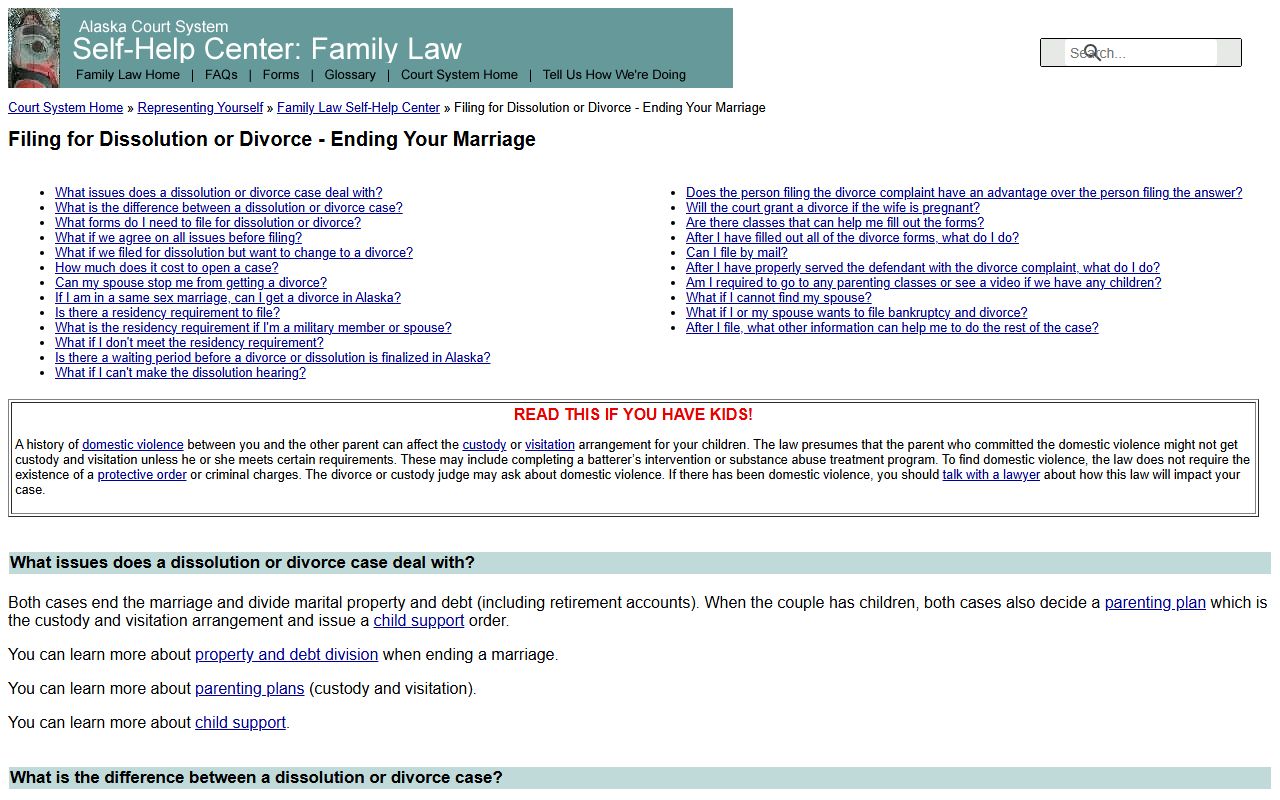
The center provides form packets, step-by-step guidance, and a helpline at (907) 264-0851 for Anchorage or toll-free at (866) 279-0851 from elsewhere in Alaska.
Nearby Cities
These nearby cities are also served by courts in the region. Each links to its own divorce decree records page.