
Hoonah-Angoon Census Area Divorce Decree
Divorce decree records for the Hoonah-Angoon Census Area are held at the Juneau Superior Court, which serves this region as part of Alaska's First Judicial District. Because the census area has no local courthouse, all divorce and dissolution cases filed by residents here go through Juneau. You can search these divorce decree records online using CourtView, Alaska's public case access system, or contact the Juneau clerk's office directly to request certified copies. Whether you need a copy of a final decree or want to look up the status of a case, the process starts with the Juneau Superior Court.
Hoonah-Angoon Census Area Overview
Juneau Superior Court: First Judicial District
Hoonah-Angoon Census Area has no dedicated Superior Court of its own. All divorce and dissolution cases from this census area are handled by the Juneau Superior Court, which sits in Juneau at 123 Fourth Street. Juneau is the regional court hub for the First Judicial District, and it maintains the case files and copy records for divorce decrees filed by Hoonah-Angoon residents. The clerk's office at this location accepts in-person requests, mail requests, fax submissions, and email requests.
The census area was created in 2007 from the former Skagway-Hoonah-Angoon Census Area. It is part of Alaska's Unorganized Borough, meaning it has no borough-level government. There is no local court clerk or county clerk equivalent here. Magistrate judges may hold scheduled proceedings in Hoonah and Angoon on certain dates, but Superior Court matters including divorce cases are handled exclusively in Juneau. If you are unsure about court schedules or travel to Hoonah or Angoon, contact the Juneau court before making any plans. The Juneau Court Directory lists all current contact details and schedules.
| Court | Juneau Superior Court, First Judicial District |
|---|---|
| Address | 123 Fourth Street Juneau, AK 99801 |
| Phone | (907) 463-4700 |
| Fax | (907) 463-3788 |
| 1JUmailbox@akcourts.gov | |
| Case Prefix | 1JU (format: 1JU-YY-#####CI) |
| Request Form | TF-311 |
| Judicial District | First |
Note: Magistrate sessions in Hoonah and Angoon cover limited matters only. Divorce filings must go to Juneau.
The Juneau Court Directory page gives current addresses, phone numbers, fax numbers, and email contacts for the First Judicial District court that handles Hoonah-Angoon divorce decree records.
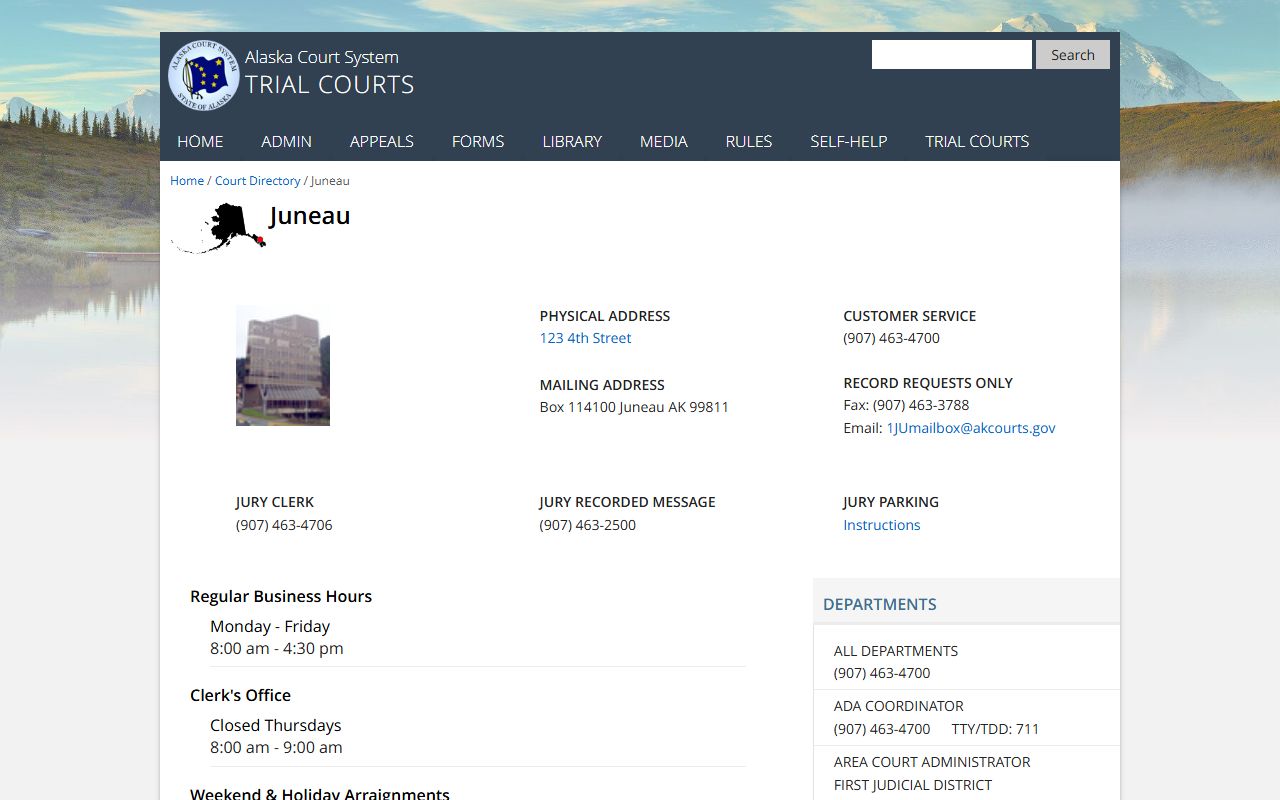
Check this directory before mailing any copy request to make sure you have the current mailing address and contact information for the Juneau clerk's office.
Search Hoonah-Angoon Divorce Decree Records
The fastest way to find a Hoonah-Angoon divorce decree is through CourtView. This is Alaska's statewide public case access system. You can search it at records.courts.alaska.gov with no account needed. Cases from this census area use the prefix 1JU followed by a two-digit year and a five-digit case number with CI at the end. A name search returns matching case records showing the case type, filing date, party names, and docket entries.
CourtView shows case index data. It does not show document images. To get the actual divorce decree or other filed documents, you need to submit a copy request to the Juneau Superior Court clerk's office. You can do that in person at 123 Fourth Street in Juneau, by mail to the same address, by fax at (907) 463-3788, or by email at 1JUmailbox@akcourts.gov. Use form TF-311 when requesting copies. This form is available from the Alaska Court System forms catalog. Include the full names of both parties, the approximate year the case was filed, and whether you need plain or certified copies.
If you do not have a case number, staff can search for it. A research fee of $30 per hour applies when staff time is needed to locate a file.
Getting Copies of a Hoonah-Angoon Divorce Decree
Copy fees at the Juneau Superior Court follow the statewide Alaska Court System schedule. Plain copies cost $5 for the first page and $3 for each page after that. Certified copies run $10 for the first page and $3 for each additional page. These fees apply to all divorce decree records held by the court for cases from Hoonah-Angoon Census Area.
Complete form TF-311 and send it to the Juneau clerk's office with payment. If you need help downloading the form, visit the Alaska Court System forms page. If you cannot afford the copy fees, form TF-920 is the fee waiver application. Submit it along with your copy request. The court reviews your financial situation and may reduce or waive the fees.
For mailed requests, processing time depends on court volume. In-person requests with a case number are usually handled the same day. Mail requests may take longer, especially given the remote nature of the census area and the volume of cases at Juneau Superior Court.
Note: Always include a return address and a contact phone number in your mailed request so the clerk can reach you if there are any questions.
Hoonah-Angoon Divorce Records at Vital Statistics
Alaska keeps two separate records when a divorce is finalized. The court holds the full case file. The Bureau of Vital Statistics holds a divorce certificate, which is a short summary document. These are not the same thing. The divorce certificate is useful for legal name changes and some government purposes, but it does not replace the full decree. When the court enters a final decree, a VS-401 statistical form is sent to Vital Statistics, which creates the certificate record.
Residents of Hoonah-Angoon Census Area can request a divorce certificate from the Alaska Bureau of Vital Statistics. The bureau handles requests online, by mail, or at its Juneau and Anchorage offices. Under Alaska law, divorce certificates are confidential for 50 years from the date of the event. Requests from parties directly named in the record or their legal representatives are typically approved. Others may need to show a legal interest in the record.
Note: The divorce certificate and the full divorce decree serve different purposes. Get the full decree from the court if you need the complete terms of the judgment.
The Alaska Bureau of Vital Statistics maintains divorce certificates for all finalized divorces statewide, including cases from Hoonah-Angoon Census Area, through its offices in Juneau and Anchorage.
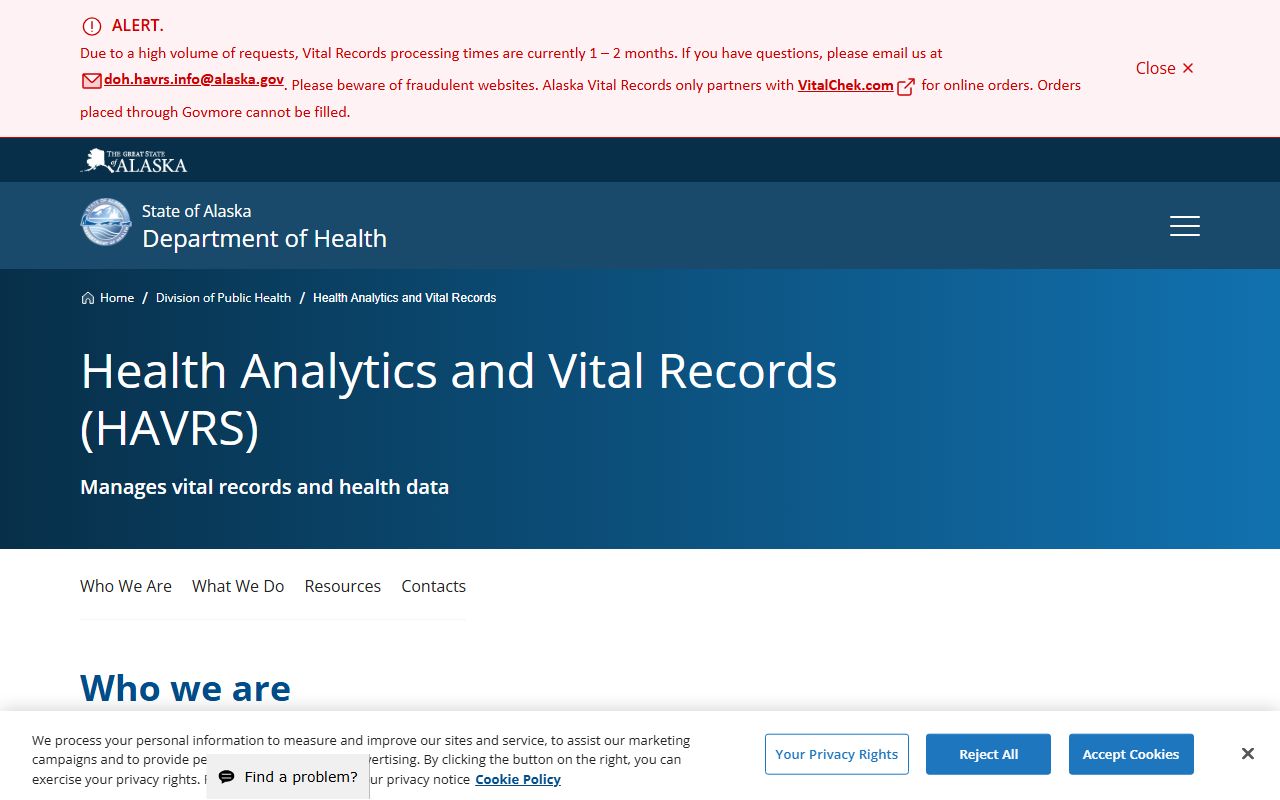
Use the Vital Statistics website to learn about eligibility, required identification, fees, and how to submit a request for a divorce certificate.
What a Hoonah-Angoon Divorce Decree Contains
A final divorce decree from the Juneau Superior Court is a legally binding court order that ends a marriage. For cases involving Hoonah-Angoon Census Area residents, this is the same document issued by the court for any First Judicial District divorce. The decree includes the full legal names of both spouses, the date the marriage is dissolved, and all terms covering property, debt, support, and any children. It also includes any name change granted by the court.
Cases without children use form DR-806. Cases involving children use form DR-805, which includes a parenting plan, custody schedule, and child support terms. The decree is the document you need for updating your name with the Social Security Administration, the Alaska DMV, financial institutions, and other agencies. It also establishes the legal end date of the marriage, which can matter for remarriage, benefits, and insurance purposes.
Most divorce decree records at the Juneau Superior Court are public records. Some records may be sealed by court order. If a case has sealed documents, CourtView will show the case exists but will not display the sealed materials. Contact the clerk's office for more information on accessing restricted records.
Divorce and Dissolution in Hoonah-Angoon
Alaska offers two ways to end a marriage. Dissolution is the uncontested option. Both parties agree on all terms before filing. This path is faster and cheaper. Divorce is the contested path. One party files and the other responds. If the two sides cannot reach full agreement, a judge decides. Both lead to the same final outcome: a divorce decree from the Juneau Superior Court.
For an uncontested dissolution without children, use form DR-100. If children are involved, use form DR-105. These forms are free to download from the Alaska Court System forms catalog. The Family Law Self-Help Center also has step-by-step guides for both paths. Alaska law requires a minimum 30-day waiting period before a dissolution or divorce can be granted after filing. The statutes governing these cases are in Alaska Statutes Title 25, Chapter 24 (AS 25.24).
Grounds for divorce in Alaska include incompatibility of temperament (the no-fault option), willful desertion, cruelty, habitual drunkenness, felony conviction, insanity, and addiction. Any of these grounds can be used for a case filed at the Juneau Superior Court by a Hoonah-Angoon Census Area resident.
Legal Help for Hoonah-Angoon Residents
The Alaska Court System's Family Law Self-Help Center is a free resource for people handling their own divorce or dissolution. It has form packets, written guides, and a helpline. The toll-free number is 866-279-0851. Staff can explain procedures and help you find the right forms, but they do not give legal advice. Given that Hoonah-Angoon is a remote area, phone and online access to this center can be very useful.
Alaska Law Help at alaskalawhelp.org offers written guides on divorce, custody, child support, and dissolution under Alaska law. These guides are free and written for people without legal training. If you need an attorney, the Alaska Bar Association has a referral service, and Legal Aid Services of Alaska handles family law matters for people who meet income guidelines. Given the geographic challenges of the Hoonah-Angoon Census Area, remote legal help by phone or video is often available and practical.
Communities in Hoonah-Angoon Census Area
There are no qualifying cities in Hoonah-Angoon Census Area with individual records pages. Key communities include Hoonah and Angoon, both of which are served by the Juneau Superior Court for divorce and family law matters.
Nearby Boroughs
These neighboring boroughs are also part of the First Judicial District or adjacent regions. Each maintains separate divorce decree records through their respective courts.